
Oneida County Deed Records by Type
Oneida County's recording schedule lists the conveyances the county clerk accepts for the deed records. Each label matters. It tells you why an instrument joined the chain of title. It also helps narrow a search of the deed index.
A recorded deed in Oneida County carries the names of the parties. It lists the land description and a recording reference. Its legal effect still rests on the document itself and the title around it.
| Deed Type | What It Does | Common Use |
|---|---|---|
| Warranty deed | Conveys the stated interest with warranties written in the instrument. | Ordinary sale or transfer |
| Quitclaim deed | Conveys whatever interest the grantor holds without the same warranties. | Interest cleanup or family transfer |
| Trustee or probate deed | Transfers land through a trustee or estate authority. | Trust or estate administration |
| Sheriff or tax deed | Records a transfer tied to an official sale process. | Recorded sale outcome |
| Patent or redemption deed | Documents a distinct source or restoration of an interest. | Historic or statutory event |
A mortgage or deed of trust is not an ownership deed. It is a financing interest riding the same recorder trail. Later assignments, reconveyances, and releases can shift that interest. Track the document type, dates, parties, reference, and legal description each time.
Reach the Oneida County Recorder
The Oneida County Clerk/Recorder/Auditor sits at 10 W Court Street in Malad, ID 83252. You can request records in person, by phone at (208) 766-4116 ext. 1100, by email at lcolton@oneidaid.us, or by mail. The county offers no grantor-grantee portal, image archive, or instrument-number search online. It lists no start year. So give the office everything that narrows the hunt. That means the parcel, situs, and legal description. Add known parties, date range, instrument type, and any prior reference. Ask for forward and reverse index work both.
The official page below is the online entry point for Oneida County deed records.
It confirms that the office records deeds, grants, transfers, and mortgages, though it displays no public search form.
Prepare an Oneida County Deed Search
Treat an office-assisted search like a careful portal query. Supply every field that can narrow the match, then request the exact recording reference.
| Request field | What to provide | Why it helps |
|---|---|---|
| Party | Grantor, grantee, trustee, estate, or entity | Finds the name index |
| Land | Parcel, situs, and legal description | Separates similar names |
| Time | Approximate execution and recording dates | Narrows the books |
| Instrument | Deed, mortgage, release, plat, or survey | Targets a category |
| Reference | Known instrument number or book/page | Points to the copy |
The county runs no property-fraud alert signup. Ask the Recorder whether one now exists rather than relying on an unofficial index.
Follow Oneida County's Grantor-Grantee Chain
A grantor-grantee index follows people or entities. The deed follows the land's legal description instead. Begin with the current owner on the Assessor's roll, but remember that the tax roll is a dated snapshot, since a newer deed may already sit in the recorder's records.
- Ask for the current owner's acquisition deed, with that owner searched as grantee.
- Read its grantor, legal description, recording date, and instrument or book/page reference.
- Search that grantor as an earlier grantee and retrieve the prior acquisition deed.
- Repeat while the land text stays continuous, noting splits, replats, and parent tracts.
- Grantor
- The party transferring the stated interest.
- Grantee
- The party receiving the stated interest.
- Chain of title
- The ordered series of instruments affecting the same land.
- Book/page
- A volume and page reference for a stored record.
- Instrument number
- A unique recording reference assigned to a filed document.
Confirm every step through the legal description, lot and block, survey, or plat. A land split can leave an older deed covering far more ground than today's parcel.
Read Mortgages Beside Oneida County Deeds
The Recorder also keeps mortgages. Deeds of trust and fixture filings are recorded there. Security agreements, assignments, releases, and reconveyances round out the collection. Search the owner as borrower or grantor. Search the lender or trustee under its recorded role too. A release may point back to the instrument it resolves.
One mortgage can cover several parcels or a parent tract. Capture both dates, the instrument number, parties, legal description, and release reference. Keep in mind that display order never establishes lien priority.
Oneida County Recording Rules in Detail
The county fee page requires a filing to be an original or certified copy, notarized, and no larger than 8.5 by 14 inches. Leave a 2 by 3 inch recording area at the top right. Recording information placed on the back adds $3.
The original comes back to you. Mailed filings need a self-addressed stamped envelope, and checks go to the Oneida County Recorder. Confirm current acceptance rules before you submit.
Fees for Oneida County Deed Records
Under the schedule effective July 1, 2017, deeds and conveyances up to 30 pages cost $15. Mortgages and deeds of trust run $45. Reconveyance is $15. Other documents, and anything over 30 pages, cost $10 for the first page plus $3 per additional page.
| Plain copy | $1 per page |
|---|---|
| Certification | $1 |
| Subdivision plat | $11 |
| Survey | $5 per page |
| Power of attorney | $25 |
The page lists no separate research charge, card policy, remote delivery method, or turnaround. Ask the office for a current estimate.
Older Oneida County Land Books
Oneida County formed in 1864. Its seat moved from Soda Springs to Malad City on January 5, 1866. The old territory was divided more than once. The last cited change came in 1919. Date the deed and place the land on a historic boundary map. Do not assume today's Oneida County office holds the entire chain.
The Idaho State Archives holds county land, property, court, vital, and tax material dating from 1863. It also holds 40,000 microfilm rolls and newspapers from 1863 forward. It sits at 2205 Old Penitentiary Road in Boise. Hours are Wednesday through Saturday, 10 a.m. to 4:30 p.m. Appointments are encouraged. Research questions can go to public.archives@ishs.idaho.gov.
The archive page below is a useful bridge. It covers deed records that predate any local digital access.
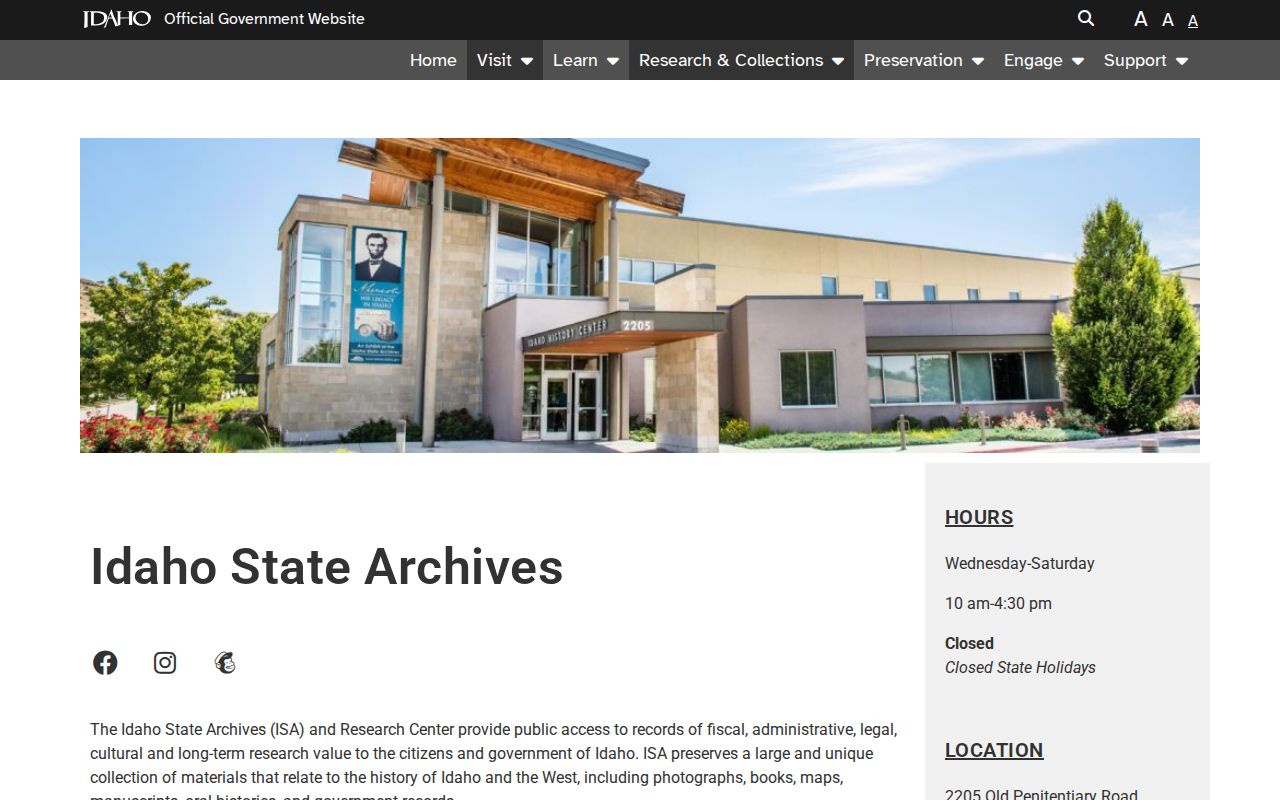
Ask for an exact Oneida County series, reel, or call number. Archive evidence stays a finding aid until it is matched to the legal instrument.
Order an Oneida County Deed Copy
There is no verified online image route for copies. Request a deed at the counter, by phone or email, or in writing. Give the recording reference when you have it, plus parties, date, type, parcel, and legal description, and say whether you need a plain or certified copy.
Recorded, not guaranteed. Oneida County deed records show what reached the Recorder; they are not a title opinion and cannot rule out unrecorded interests.
When standard channels come up empty, the county records-request route is the next step. A good written request names the custodian and the land. It also covers the document type and the date range. State the format you want. Ask for a fee estimate too.
For mail, tell staff whether you need the full instrument or just the index reference. A self-addressed stamped envelope helps if the office asks for one. A deed sometimes points to another deed, mortgage, assignment, or release. Order that cross-referenced record separately. Those linked documents often close a gap that a single deed cannot. While you work, keep a log of every search term and every response. Include spellings tried, index direction, dates checked, legal descriptions, instrument references, and copy types. The log earns its keep when a trust changes punctuation. An estate may surface under a representative. An older tract may have been split later. It also shows Recorder staff exactly what has already been searched.